
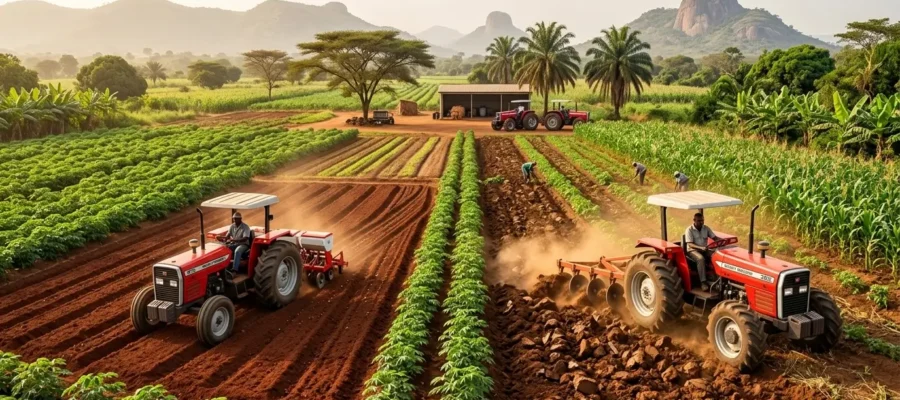
A farm tractor increases crop yield by mechanizing key agricultural tasks — including land preparation, planting, fertilizing, and harvesting — faster and more precisely than manual labor allows. For Nigerian farmers, integrating a tractor into daily farm operations can dramatically improve output, reduce costs, and strengthen food security.
Nigeria is one of Africa’s largest agricultural economies, yet many farmers still rely on manual methods that limit productivity. Transitioning to mechanized farming with a reliable tractor is one of the most impactful steps a Nigerian farmer can take to grow more crops, more efficiently.
Why Do Farm Tractors Increase Crop Yield?
Farm tractors increase crop yield by enabling faster, more consistent field operations across larger areas of land. Tasks that would take labourers days to complete — such as ploughing, harrowing, and planting — can be done in hours with a tractor, reducing delays that affect crop growth cycles.
Key reasons tractors improve yield include:
- Faster land preparation: Tractors equipped with disc ploughs and harrows break and turn soil thoroughly, creating ideal growing conditions for seeds
- Improved soil quality: Deep, consistent tillage aerates soil and improves water retention, supporting stronger root development
- Timely planting: Tractors allow farmers to plant at the optimal time in the growing season, which directly affects final yield
- Efficient fertiliser application: Tractor-mounted fertiliser spreaders ensure even distribution across the field, reducing waste and improving nutrient uptake
- Reduced crop losses at harvest: Mechanised harvesting minimises the damage and delays that lead to post-harvest losses
How Does a Tractor Help with Land Preparation in Nigeria?
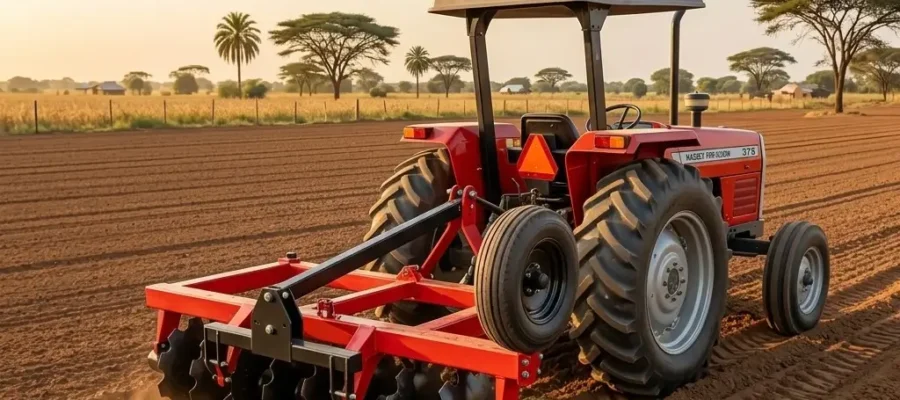
Proper land preparation is the foundation of a productive harvest. A tractor fitted with a disc plough can break new ground, turn over existing soil, and work across rocky or uneven terrain — conditions common across many Nigerian farming regions.
Once ploughed, a disc harrow further refines the soil structure, breaking up clumps and creating a smooth, even seedbed. This level of preparation is difficult to achieve consistently through manual labour and makes a measurable difference to germination rates and early crop development.
What Farming Tasks Can a Tractor Automate?
A farm tractor, combined with the right implements, can mechanise nearly every stage of the crop production cycle:
- Ploughing – Turning and aerating soil before planting
- Harrowing – Smoothing and refining the seedbed
- Planting – Using bed-shape planters for accurate, efficient seed placement
- Fertilising – Spreading fertiliser evenly across large fields
- Spraying – Applying pesticides and herbicides with a boom sprayer
- Harvesting – Cutting and collecting crops with reduced manual effort
- Transport – Moving produce across the farm using a farm trailer or trolley
Each of these tasks, when done more precisely and on time, contributes directly to higher crop output per hectare.
Which Tractor Is Best for Nigerian Farmers?
The best tractor for Nigerian farmers depends on farm size, terrain, and the crops being cultivated. Massey Ferguson tractors — available in Nigeria through Massey Ferguson Nigeria — are widely regarded as a reliable choice, offering models from 50 HP to 85 HP suited to a range of farming conditions.
Popular models available in Nigeria include:
- Massey Ferguson MF 240 (50 HP) – Well-suited for smallholder farms and lighter tillage work
- Massey Ferguson MF 260 (60 HP) – A versatile mid-range option for mixed crop farming
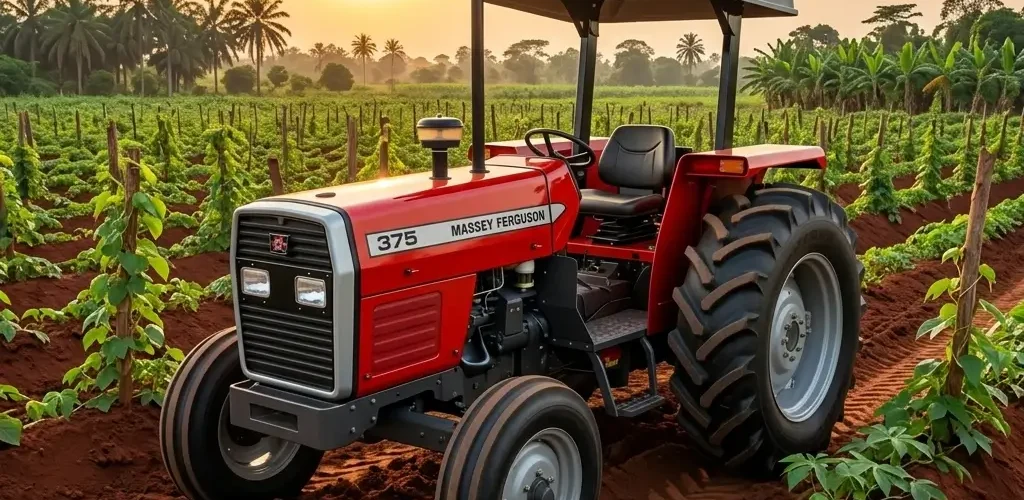
- Massey Ferguson MF 375 (75 HP, 2WD & 4WD) – Ideal for larger farms and more demanding terrain
- Massey Ferguson MF 385 (85 HP, 2WD & 4WD) – High-output performance for commercial-scale operations
According to Massey Ferguson Nigeria, the MF-375, MF 240, and MF 260 are among the most popular models with Nigerian farmers due to their durability, performance, and cost-effective maintenance.
How Does Mechanised Farming Reduce Costs and Increase Profit?
A tractor reduces reliance on manual labour, which represents one of the largest ongoing costs in traditional Nigerian farming. By completing more work in less time, farmers can:
- Cultivate larger land areas without proportionally increasing labour costs
- Reduce post-harvest losses caused by delays in manual harvesting
- Apply inputs such as fertiliser and pesticides more efficiently, cutting waste
- Take on additional growing cycles per year, increasing annual revenue
Over time, the investment in a quality tractor pays for itself through improved output and lower operational costs per hectare.
Frequently Asked Questions
Can a tractor be used for multiple crop types in Nigeria?
Yes. Tractors paired with interchangeable implements — such as planters, sprayers, and harrows — can support a wide variety of crops, including maize, rice, cassava, and wheat. This flexibility makes a single tractor a versatile investment for mixed-crop Nigerian farms.
How do I choose the right horsepower tractor for my farm in Nigeria?
Smaller farms of up to 10 hectares are typically well served by a 50–60 HP tractor such as the Massey Ferguson MF 240 or MF 260. Larger farms or those with harder terrain benefit from 75–85 HP models like the MF 375 or MF 385. A tractor supplier can advise based on your specific land and crop requirements.
Where can I buy a farm tractor in Nigeria?
Massey Ferguson tractors are available for sale across Nigeria through Massey Ferguson Nigeria, with coverage in major cities and states including Lagos, Kano, Abuja, Port Harcourt, Ibadan, Kaduna, and Enugu, among others.
For Nigerian farmers looking to increase crop yield, a farm tractor is not a luxury — it is a practical investment with measurable returns. From soil preparation to harvest, mechanised farming enables more consistent, productive, and profitable operations.

Related Posts
Post a Comment